clear

POPULAR CONTENT
HISTORY
|Clear All History
Engine Parts

Clear All History
December 23, 2025 · 3 min read
When planning a high-performance street or track build, one big question looms:
Which V8 engine platform should I use ? Ford’s modern Coyote or GM’s ubiquitous LS?
Both engines deliver serious power, but they differ in design, cost, tuning, and reliability. This leaves many enthusiasts frustrated by conflicting advice and fear of picking the “wrong” engine for their budget and goals. We’ve heard it all:
“LS swaps are cheaper, but Coyotes rev higher.”
“Coyote fuel economy is better.”
“Parts are harder to find for one or the other.”
These debates can be maddening and ultimately cost you time and money. The good news: this article cuts through the noise. We’ll define each engine family, compare them side-by-side on horsepower, cost, availability, tuning ease, and real-world reliability – even sharing actual dyno and community data – so you can decide logically which V8 rules your next build.
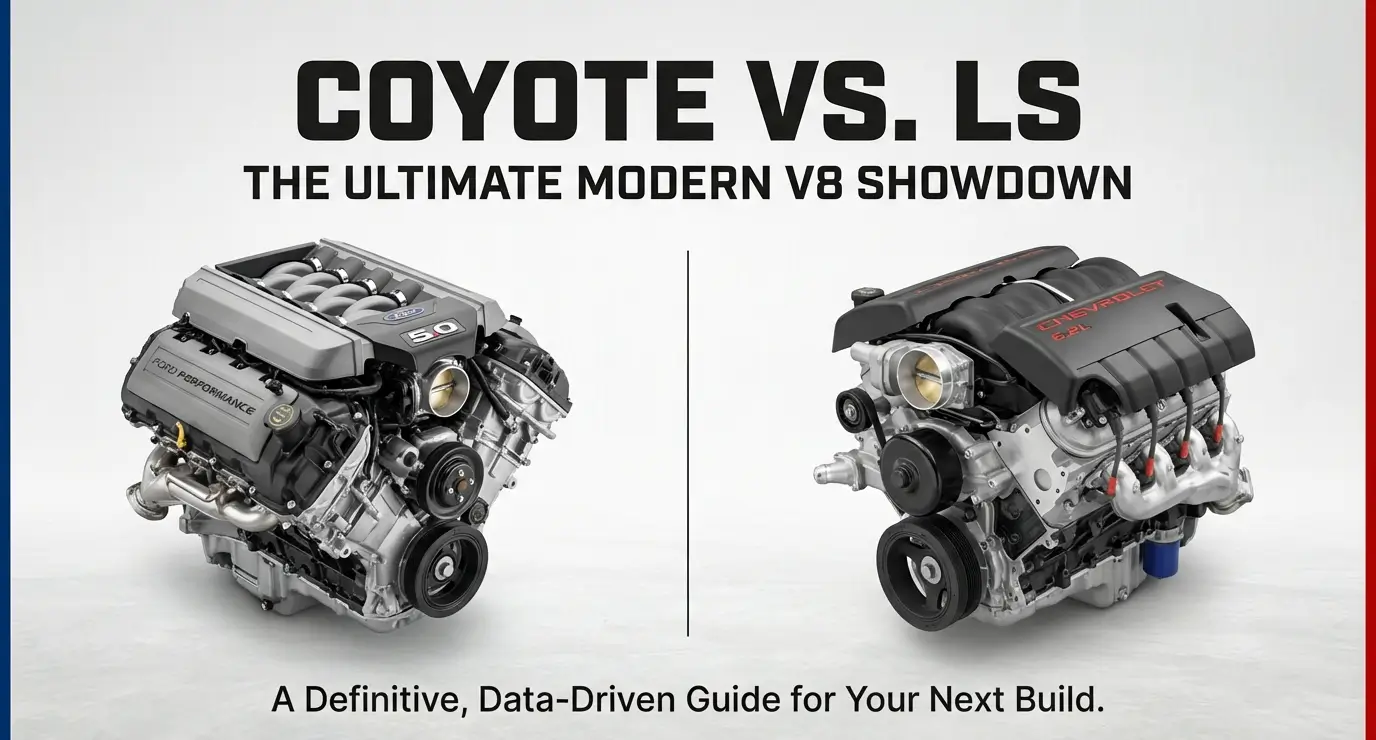
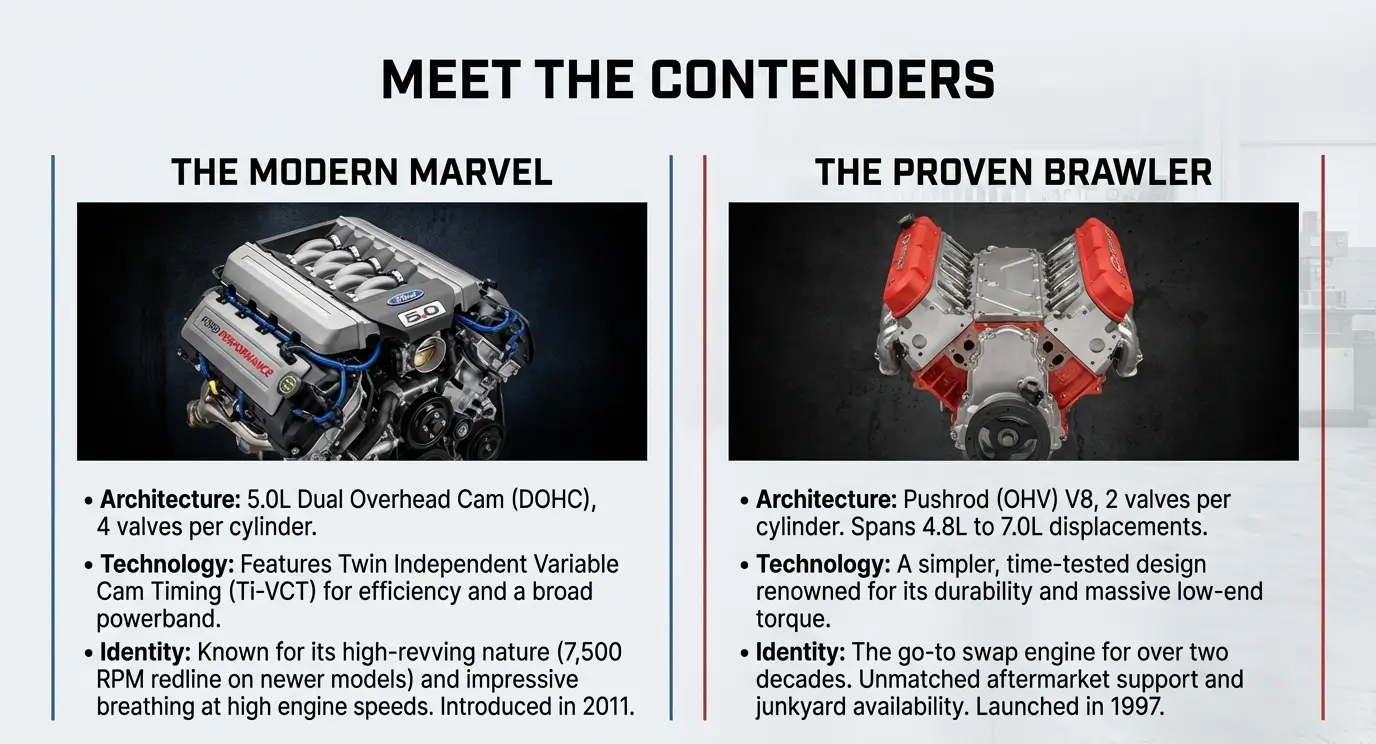
The Ford Coyote is a 5.0L dual overhead-cam (DOHC) V8 introduced in 2011 for the Mustang GT and F-150. It’s an all-aluminum, four-valve-per-cylinder design with twin independent variable cam timing (Ti-VCT) and direct + port fuel injection.
Early Gen1 Coyotes (2011–2014) produced about 412–420 hp, Gen2 (2015–17) around 435 hp, Gen3 (2018–20) about 460 hp, and the latest Gen4 (2021+) up to 480–486 hp in naturally aspirated form. Ford’s production Coyote engines are known for high-revving power (redline near 7,200–7,500 rpm on newer models) and relatively smooth torque.
For example, the 2024 Coyote crate engine (Ford Performance part M-6007-M50D) is rated at 480 hp @ 7,150 rpm and 415 lb-ft @ 4,900 rpm. These engines were factory-fit in Mustangs (2011+ GT, 2019-20 Bullitt, 2021+ Mach 1) and trucks (2011+ F-150), proving their versatility. The Coyote’s DOHC design delivers impressive breathing and efficiency for a V8, making it popular for modern performance upgrades.
The GM LS (also called the Gen III/IV small-block) is a family of pushrod V8s launched in 1997.
Originally introduced in the Corvette C5 (LS1 5.7L) and Chevy/GMC trucks (4.8L/5.3L iron-block motors), the LS line spans displacements from 4.8L up to 7.0L (LS7) or even 6.2L supercharged (LS9).
Its cast-aluminum blocks (and iron-block truck variants) and two-valve pushrod heads have proven extremely durable. Stock outputs ranged from about 270 hp for a basic 4.8L truck LS to 430 hp for an LS3 (6.2L, Camaro/Corvette) and up to 505 hp for the aluminum LS7 (7.0L Corvette Z06). Some high-end LS variants (like the LS9 supercharged crate engine) were rated near 638 hp stock.
The LS’s broad family means there’s an LS engine for almost any project – from budget 4.8L truck blocks (300+ lb-ft) to high-revving aluminum racing engines. Thanks to decades of use in cars and trucks, “LS” has become shorthand for a light, powerful V8 swap with almost infinite aftermarket support.
Both engines are strong performers, but their designs differ: the Coyote’s DOHC heads flow exceptionally well at high RPM, while the LS’s compact OHV heads excel in low-end torque. We’ll quantify those differences below.
To understand the rivalry, you must understand the engineering philosophy:
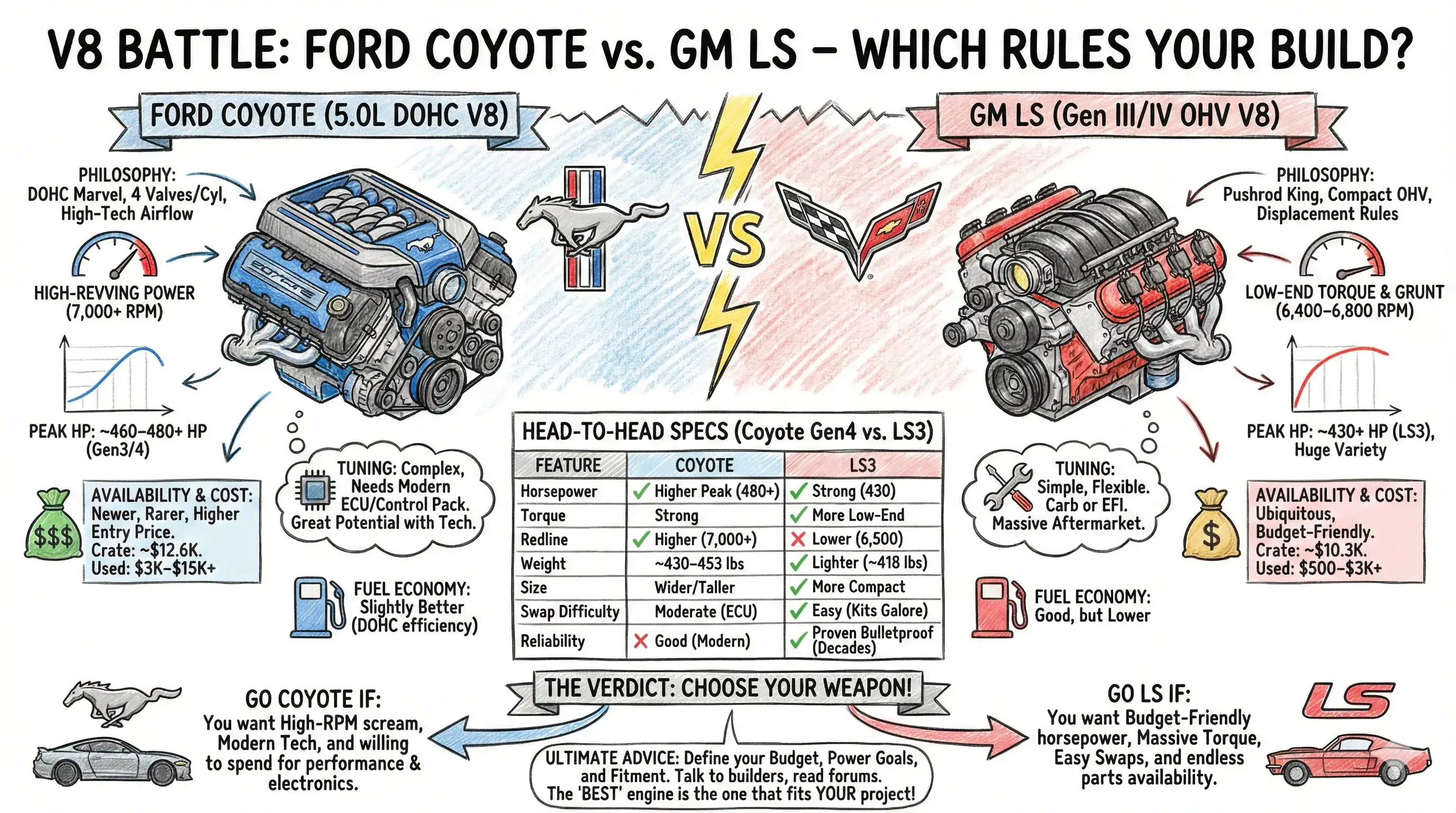
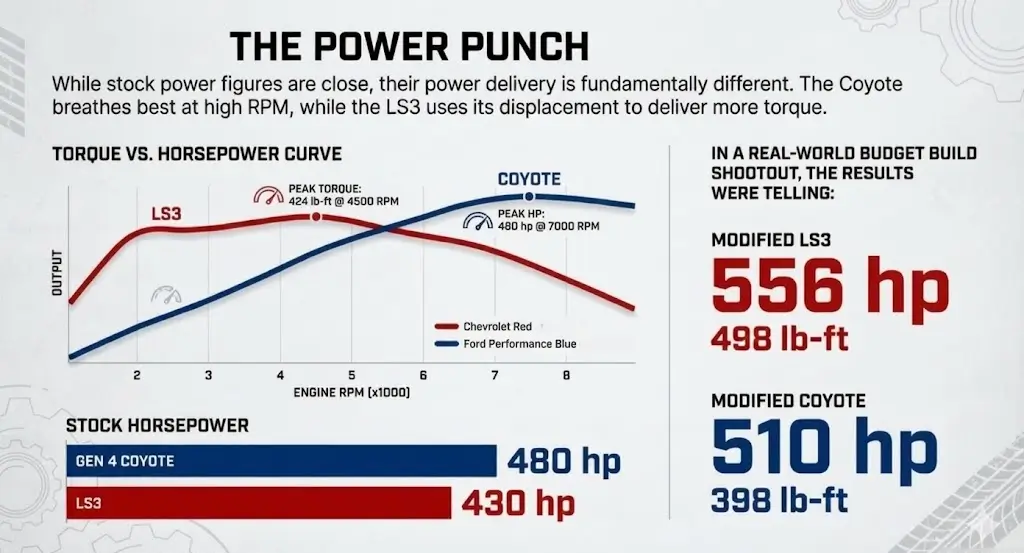
In factory trim, a Coyote and LS3 are roughly similar in power: ~460–480 hp for the latest 5.0L Coyote vs. 430 hp for a GM LS3 (6.2L). (For reference, Ford’s 2024 Coyote crate motor makes 480 hp.) However, the Coyote typically needs to rev higher to hit peak power (~7,000+ rpm) whereas the LS3 peaks earlier (~6,500–6,800 rpm). Both engines respond well to modification. In one real-world budget build, a Ford Coyote made 510 hp and 398 lb-ft of torque on the dyno, while a similarly built LS3 made about 556 hp and 498 lb-ft. That test showed the LS3 had an edge in absolute output (due partly to its larger 6.2L displacement) but the Coyote’s four-valve heads gave it strong high-rpm breathing. When pushrods meet overhead cams, the numbers speak: even with similar parts, LS builds tend to make slightly more torque low-down, while Coyotes rev farther and make strong high-end power.
Both platforms enjoy huge aftermarket ecosystems. You can find everything from camshafts and intakes to superchargers or turbo kits for either motor. Coyotes benefit from modern features like four valves per cylinder and advanced engine controls, which lend themselves to big power gains – for example, a Whipple-supercharged “Resto-Mod” Coyote can exceed 700–800 hp on pump gas. LS engines, being simpler, are also easily boosted or nitrous-fed. EngineLabs’ recent dyno wars showed that with equal turbocharging, a Coyote and GM Gen V LT1 (pushrod) made nearly identical peak power – though they noted the Coyote’s block can handle >2,000 hp (with sleeves) better than the stock LT block. In short, both engines have been pushed to 1,000+ hp in competition builds.
In practice, LS swaps have a slight edge in parts count and affordability because the platform has been around longer. Virtually every manufacturer of performance parts (from carbureted setups to modern EFI controllers) supports LS, and used LS heads/blocks are cheap and abundant. By contrast, Coyote parts are newer and can cost more. For tuning, some builders even find the Coyote simpler: one dyno shop noted that “tuning this Coyote was easier than tuning the LS3, because the stock computer never had to be reflashed again – the LS3 required a lot more reflashes for wideband tuning”. (On the other hand, the Coyote does require a modern ECU and wiring pack or adapter kit, whereas an LS can often be run carbureted or with any standalone EFI.)
The table below summarizes key specs of a Ford Coyote (Gen4 5.0L) vs. a GM LS3 (6.2L) for head-to-head context:
| Specification | Ford 5.0L Coyote (Gen3/4) | GM 6.2L LS3 (Gen IV) |
|---|---|---|
| Valvetrain / Layout | DOHC, 4 valves per cyl. | OHV pushrod, 2 valves per cyl. |
| Displacement | 302 cu in (5.0L) | 376 cu in (6.2L) |
| Stock Power (HP / lb-ft) | ~460–480 hp, ~420 lb-ft† | 430 hp, 424 lb-ft† |
| Rev Limit (stock) | ~7,000–7,250 rpm | ~6,400–6,600 rpm |
| Weight (eng. only) | ~430–453 lbs (with accessories) | ~418 lbs (with accessories) |
| Length × Width × Height | 26.08 × 29.05 × 28.89 in | 28.75 × 24.75 × 28.25 in |
| Crate List Price‡ | ~$12,650 (new Ford crate) | ~$10,300 (new GM crate) |
| Used Engine Price | $3k–$15k (depending on gen) | $500–$3,000 (e.g. 4.8–5.3L trucks) |
| Aftermarket Availability | High (growing) | Very High (dominant) |
| Ease of Swap† | Moderate (needs modern ECU) | Easy (kits & harnesses widely available) |
| Fuel Economy | Slightly better (DOHC, TI-VCT) | Good but lower (pushrod) |
Coyote figures are for later-generation 5.0L engines; earlier Gen1/2 were 420–435 hp. LS3 specs from GM .
Crate prices and used prices approximate at time of writing.
From the table and sources above, the LS3 has a bit more torque and is smaller/lighter, while the Coyote makes more peak horsepower and revs higher. The Ford Performance Gen4 Coyote crate motor (480 hp) lists for about $12.6K, whereas an LS3 crate is around $10.3K. Used LS engine cores (especially iron-block 4.8/5.3L from trucks) often sell for less than $1K due to junkyard abundance, whereas a good used Coyote (from a Mustang or F-150) might still cost several thousand.
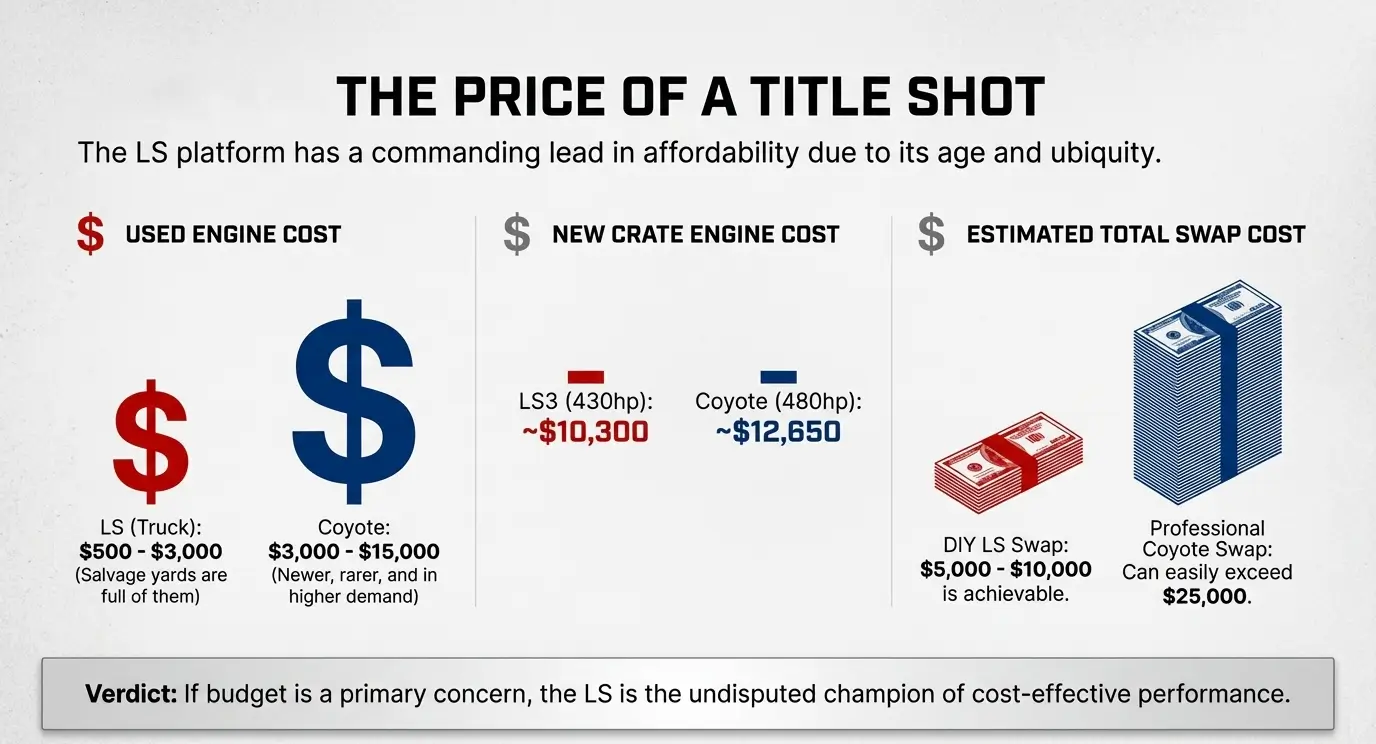
The GM LS-series has been sold in tens of millions of vehicles (cars, trucks, SUVs) for over 25 years. Salvage yards are full of low-hour LS blocks and heads, and even late-model Corvette engines frequently find their way onto the used market. This means you can often buy a complete running LS engine for a few hundred dollars or get a high-quality used crate engine for under $3,000.
In comparison, Coyote engines (being newer) are rarer in junkyards. A cleaned-up 5.0L Coyote long-block might fetch $5,000–$10,000 used, or more for low-mileage Mustang donors. New Coyote crate engines (5.0L 480 hp) cost around $12–13K, whereas new LS crate engines (6.2L 430 hp) are around $10K. Even beyond the engine core, swaps usually require harnesses, mounts, and ECU modules. LS swap kits (for classic cars) have become commodity items, but a Coyote often needs Ford’s EFI control pack or a custom harness (adding to cost).
Wade’s Motorsports estimates a total Coyote swap (including engine, wiring, cooling, fuel mods, labor) can easily exceed $25,000 in a professional shop. LS swaps, on the other hand, are often done on a tighter budget; enthusiasts report $5–10K for an LS swap into common cars (since the engine itself can be so cheap and parts plentiful). As one tuning company put it, if you’re swapping an LS into a non-GM car “it can be done for far less money”. In summary: if budget and parts availability are priorities, the LS platform is usually cheaper and easier to source.
Both Coyote and LS have extensive aftermarket support, but in slightly different ways.
Enthusiasts can find virtually limitless parts for both: from upgraded camshafts, intake manifolds, and headers to high-flow fuel rails and supercharger kits. Because the LS family is older and more ubiquitous, cheaper basic upgrades (like ported heads or junkyard intake manifolds) are easy to come by. The Coyote, with its DOHC architecture, has seen rapid development of high-tech parts (e.g. CNC-ported 4V heads, dual throttle bodies, etc.).
Tuning wise, the LS is famously simple: its stock crank-trigger distributorless ignition makes it easy to run on standalone ECUs or even carburetors. By contrast, a Coyote needs a modern ECU or Ford Performance control pack to operate its variable cam timing and fuel injection.
However, with the right hardware, the Coyote’s sophisticated control also yields great tunability. Interestingly, one dyno test noted that “tuning the Coyote was easier than tuning the LS3” in their specific setup – the Coyote’s fuel curve stayed very stable, while the LS’s stock ECU required multiple reflashes to accept custom maps. In practice, though, the choice is clear: if you want a plug-and-play build with off-the-shelf swaps, the LS wins; if you want the latest Ford technology and are willing to sort electronics, the Coyote shines.
Both engines are generally reliable when cared for, but their track records differ by vintage.
The GM LS design is proven over decades: many LS-powered cars routinely exceed 200,000+ miles on the original engine with no major failures. The simple pushrod heads and robust blocks tolerate abuse (and boost) very well. Early LS engines did have issues like lifter tick or main cap windage, but these are often cured in a proper build.
The DOHC Coyote is a newer design (about 15+ years old), so its long-term 300k-mile reliability is still emerging. So far, Coyotes have shown few intrinsic flaws, though they do have more parts (valve covers, lifters, timing chains). Factory improvements (for example, newer cam phasers and head bolts) have addressed early Coyote issues. Owner anecdotes suggest that a well-maintained Coyote can last over 150–200k miles, but the consensus is “take care of the maintenance”. Compared head-to-head, LS has the historical edge in bulletproof durability, while Coyote reliability is good but less battle-tested.
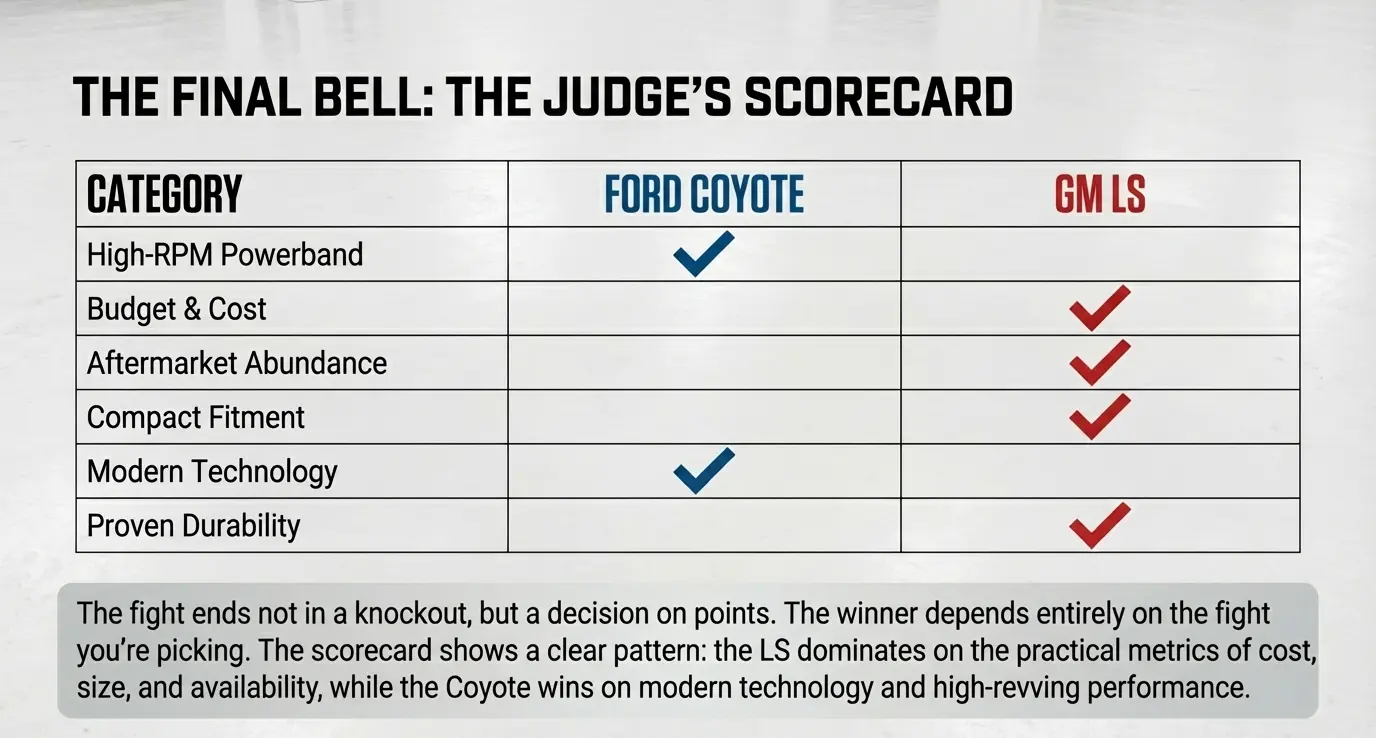
LS engines have powered everything from muscle cars to dragsters to rock crawlers. Coyote engines are popular in late-model Mustang builds and have even been shoehorned into Fox-body Mustangs, Broncos, and more with aftermarket kits. For street use, either can be made smooth and powerful. On the track or strip, LS’s extra torque and low-end grunt often help in heavy cars, while Coyote’s high-rpm hat trick suits lighter, high-rev designs. Community polls and forum discussions show both camps of loyal fans, but a recurring theme is: “if you need cheap power and availability, LS; if you want modern tech and high-rev power, Coyote.” This article aims to give data, not dogma, to help you decide.
| Feature | Ford 5.0L Coyote (Gen3/4) | GM LS3 6.2L (Gen IV) |
|---|---|---|
| Stock Horsepower | Up to 480 hp (2021+ model) | 430 hp |
| Stock Torque | ~420 lb-ft | 424 lb-ft |
| Redline (stock) | ~7,000–7,250 rpm | ~6,400 rpm |
| Dry Weight | ~430–453 lbs (eng. only) | ~418 lbs |
| Dimensions (L×W×H) | 26.1" × 29.1" × 28.9" | 28.8" × 24.8" × 28.3" |
| Typical Used Price | $3,000–$15,000 (used Mustang/F-150) | $500–$3,000 (used trucks, etc.) |
| Crate Engine Price | ~$12,650 (2024 crate) | ~$10,300 (LS3 crate) |
| Aftermarket Support | High, growing (many DOHC parts) | Very High (established OHV parts) |
| Swap Difficulty | Moderate (requires ECU/harness) | Easy (many kits, simple ECU) |
| Fuel Economy | Better (4-valve, TI-VCT) | Good (older design, fixed heads) |
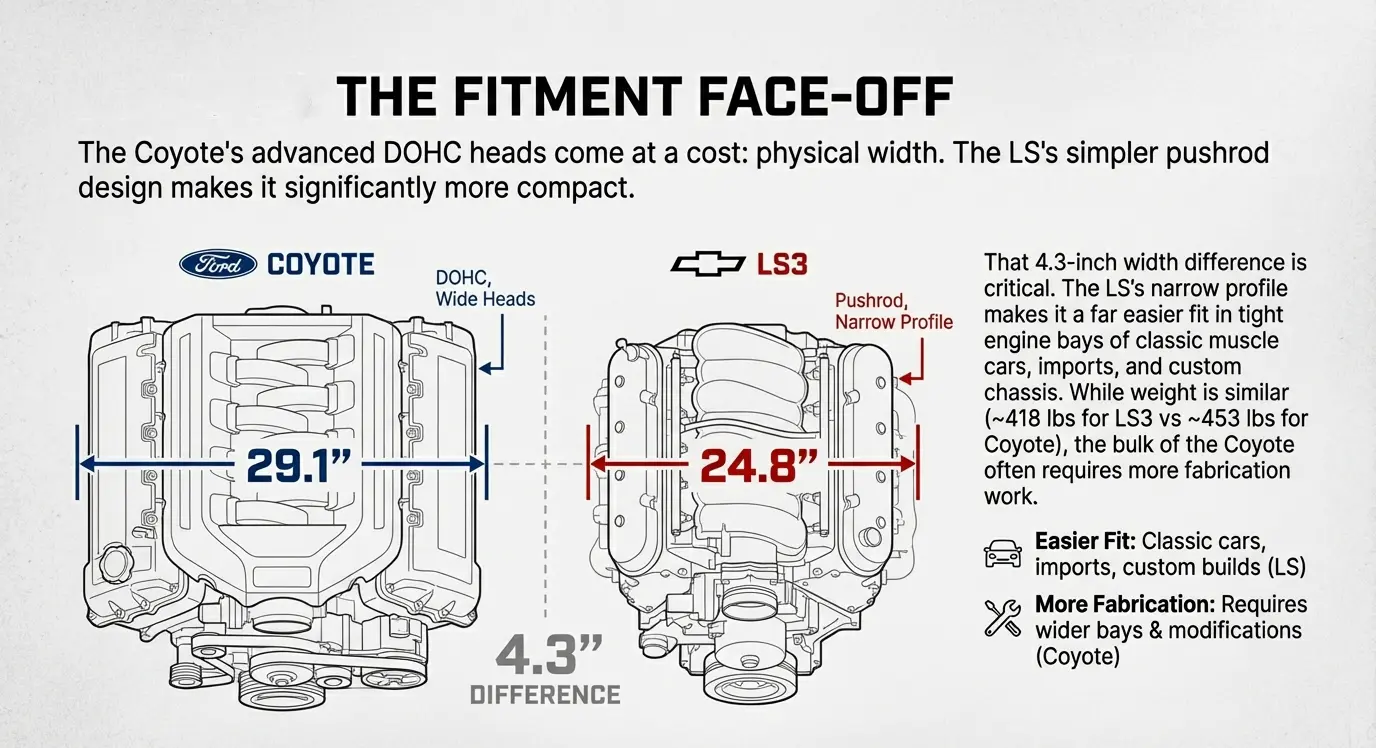
Both the Ford Coyote and GM LS platforms have proven themselves in countless builds. As you decide, focus on your priorities: Budget (LS has the advantage), Powerband (Coyote revs higher), Availability (LS is everywhere), Tech (Coyote is modern), and Fitment (LS is more compact). Talk to builders who have done swaps similar to your car, and read build threads for whichever platform you’re leaning toward. Ultimately, the “best” engine is the one that matches your build goals and wallet.
If you’re ready to start building, consider checking out our selection of performance crate engines and swap kits. Whether you want a Ford 5.0L Coyote ready for bolting in or a GM LS3 6.2L for swapping into your project, we have parts and guides to help. Explore our engine category pages (Coyote crate engines, LS crate engines) and build guides to kick off your project. With the facts laid out above, you can choose the platform that fits your power goals – and then get the parts you need to make it happen.
List your build requirements (horsepower target, vehicle type, budget) and revisit the comparison above. For street/track duty with high RPM, lean toward a Coyote; for low-end torque and economy of swap, lean LS. Whichever you choose, dive into the rich aftermarket community for that platform. And of course, always double-check fitment, wiring, and local emissions laws before diving into the swap. Good luck building your ultimate V8!
A: The Ford Coyote debuted in the 2011 Mustang GT and is now in all 5.0L Mustangs (and Ford F-150 trucks). In contrast, the LS family was offered in hundreds of GM models (Chevy and GMC trucks and SUVs, Camaros, Corvettes, Pontiac GTO, etc.) starting in 1997. This means salvage LS cores are everywhere, whereas Coyotes usually come from Mustangs or late F-150s.
A: Factory stock, a late-model Coyote (Gen3/4 5.0L) makes about 460–480 hp, slightly higher than a stock LS3’s 430 hp. However, the LS family includes bigger blocks (like the 505-hp LS7 or 638-hp supercharged LS9) beyond the 6.2L LS3. Aftermarket tuning can easily push both engines well past 600 hp naturally aspirated, and over 1,000 hp with boost. In real-world tests, a built LS3 outproduced a similarly built Coyote by a bit (556 hp vs 510 hp), but the Coyote revved higher.
A: The LS3 is actually a bit lighter and narrower than the Coyote. A comparison dyno report lists the Coyote at ~430 lbs and 29.1" wide vs. the LS3 at ~418 lbs and 24.8" wide. In other words, LS engines pack into tight spaces more easily (narrow valley, fewer accessories), whereas the Coyote’s DOHC heads make it a little wider and taller. If your project has a tight engine bay, the LS tends to fit more easily.
A: In general, LS swaps are cheaper. A used LS iron-block truck engine might cost only a few hundred dollars, and cheap aftermarket swap kits exist for many chassis. A complete DIY LS swap (engine + transmission + accessories) can be done for $5–$10K by a knowledgeable builder. By contrast, a quality used Coyote often runs into the mid-thousands, and swapping it requires modern parts (fuel pump, control pack, custom mounts). Wade’s Motorsports estimates a full Coyote swap (engine + necessary mods) can easily exceed $25,000 if done professionally. For most projects, plan on spending more to drop in a Ford Coyote (new crate is ~$12.6K) than a GM LS (crate ~$10K or used for much less).
A: The LS is known for its simplicity – you can bolt on cam, intake, or turbos with a wide variety of support, and even run it carbureted or with generic EFI. There are countless bolt-on packages and tunes. The Coyote, with its dual cams, requires electronic tuning (Ford ECU or aftermarket) to unlock, but modern tuning tools are available. Interestingly, a Westech dyno engineer noted that tuning their Coyote was “easier than tuning the LS3” in a drag-car build because the LS’s stock PCM needed more reflashes. In short, both engines accept power upgrades well, but expect to deal with a modern EFI system for the Coyote.
A: LS engines have the proven track record. Many LS-powered vehicles (from tanks to cruisers) have gone 200,000+ miles on original internals. The simple pushrod design means fewer moving parts, which often translates to durability. Coyotes are robust too but being newer, we’re still collecting long-term data. So far, Coyotes have shown good reliability with proper maintenance. Owners report getting well over 150,000 miles without major engine issues when oil and services are done on time. There have been occasional recalls on early Coyotes (e.g. valvetrain parts), but Ford addressed most of them. Bottom line: both engines can be very reliable if not pushed beyond their limits or neglected, but the LS enjoys a half-century head start in proving itself on the road.
A: Yes, with work. Swapping an LS into a Ford chassis (or any non-GM vehicle) is very common, and there are numerous LS swap kits (mounts, oil pans, harness adapters) for Fords, old GMs, even imports. Swapping a Coyote into a non-Ford car is also possible, but requires more custom work (e.g. mounts, cooling, and especially wiring). Ford sells a “Control Pack” wiring harness for retrofits, but many Coyotes end up in classic Mustangs or custom builds. In short, LS swaps are more universally “plug-and-play”, whereas Coyote swaps often stick within the Ford ecosystem (unless you’re prepared for custom fab and wiring).
A: The DOHC Coyote has a slight efficiency edge due to its variable cam timing and four-valve heads. As one source notes, the Coyote “holds an advantage… and can offer better fuel economy compared to the LS engine”. In practical terms, both are thirsty if you’re on the gas, but a mild Coyote may idle a bit more gently in town. For a street cruiser worried about MPG, know that neither is going to sip fuel like an economy car — they’re high-performance V8s. However, if you plan to regularly commute or want a daily driver vibe, the Coyote’s newer tech and higher compression could deliver a few extra MPG under light throttle.
A: It depends on your goals. If maximum power and high-RPM fun are your priorities (e.g. a Mustang drag car or road racer), the Coyote’s DOHC design and variable cams might appeal. If budget, simplicity, and massive torque (for towing or building a crate motor on the cheap) are your top concerns, the LS platform is likely the winner. Ask yourself: Do you mind paying more for modern hardware and using a 2018 Mustang harness? Or do you want the cheapest 400+ hp you can get? Both engines can make 800+ hp with bolt-ons and boost, so the choice often comes down to style: Ford vs Chevy heritage. There’s no single “best” — each engine will work great if matched to the right car and build plan.


 Xiang Lee
 Mark Thompson


 Contact Us