clear

POPULAR CONTENT
HISTORY
|Clear All History
Engine Parts

Clear All History
December 18, 2025 · 3 min read
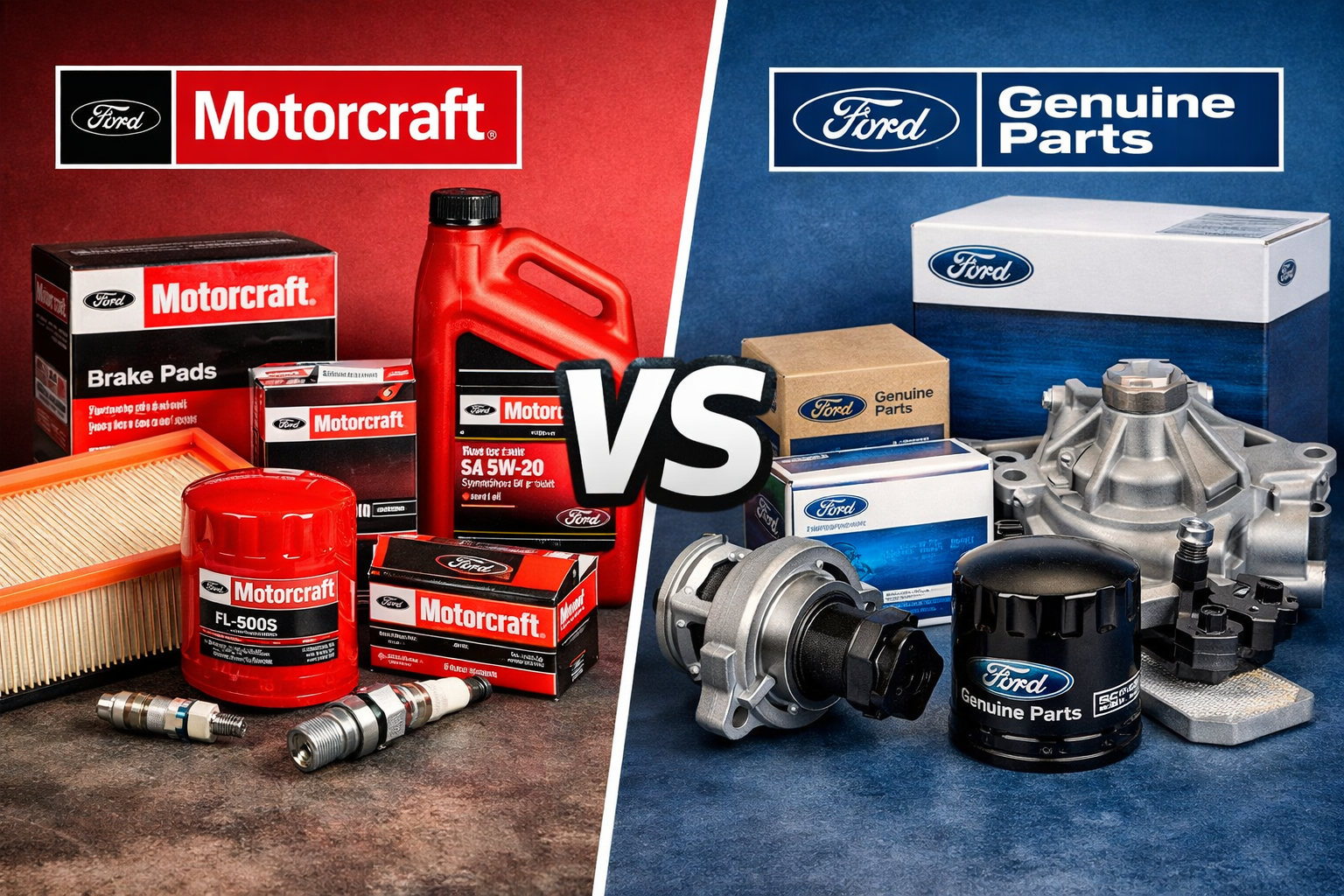
The distinction between Motorcraft and Ford Parts is rarely explained clearly. Most articles either oversimplify the topic or repeat marketing language without context. In reality, the relationship between the two is the result of historical decisions, supply-chain evolution, and Ford’s long-term service strategy.
Understanding that background matters—not just for enthusiasts, but for anyone trying to buy parts without guesswork.
For much of the 20th century, Ford Motor Company did not operate under a unified service-parts identity. Replacement components were supplied by a mix of internal divisions and external manufacturers, often sold under names like Autolite, or simply distributed without strong brand consistency.
This worked when vehicles were mechanically simple. But by the late 1960s, several pressures began to expose cracks in the system:
Ford needed tighter control—not only over manufacturing, but over what happened after the vehicle left the factory.
Motorcraft emerged in the early 1970s as Ford’s answer to that problem. It replaced Autolite as Ford’s primary service-parts brand and gave the company something it previously lacked: a unified, recognizable identity for replacement parts.
The intent was pragmatic:
Motorcraft was never meant to be a marketing flourish. It was a control mechanism.
You can still see how Ford presents the brand today on Motorcraft’s official site:
https://www.motorcraft.com/
The emphasis is not lifestyle or performance—it’s maintenance, compatibility, and service clarity.
One of the most persistent misconceptions is that Motorcraft parts are always identical to the components installed at the factory.
Historically, that assumption doesn’t hold up.
As vehicles stayed in production longer and supply chains globalized, Ford—like every major automaker—had to adapt:
Motorcraft parts are best described as Ford-approved service replacements. They are engineered to meet functional and regulatory requirements, but they are not guaranteed to be manufacturing-identical to the original assembly-line part.
This distinction explains much of the modern confusion.
Unlike Motorcraft, Ford Parts is not a brand with a launch date or a fixed catalog. It evolved organically as Ford built a formal system around:
Today, “Ford Parts” is how Ford refers to its official parts ecosystem. That ecosystem includes Motorcraft, but also includes Ford Genuine Parts, accessories, and other Ford-approved components.
Ford’s own official parts portal reflects this system-level approach:
https://parts.ford.com/
The site is operated by Ford Motor Company, but orders are fulfilled through its authorized dealer network—a structure that prioritizes traceability and warranty coverage over branding purity.
The ambiguity is not accidental.
Ford has consistently prioritized:
Brand boundaries matter less internally than whether a part does what it’s supposed to do—without triggering fault codes, emissions failures, or warranty disputes.
That philosophy makes sense from an engineering and legal perspective, even if it frustrates consumers looking for neat labels.
In practice, buyers tend to follow simple heuristics:
Professional workshops rarely commit to one label exclusively. They choose based on risk tolerance, availability, and customer expectations.
Rather than ranking sources, it’s more useful to understand what each channel is typically used for.
This is Ford’s own front-end for parts lookup and purchasing. It’s commonly used to:
Examples include:
These are individual Ford dealerships selling parts online, often at prices lower than in-store counters. They’re widely used by experienced buyers who already know what they need.
Not a primary sales channel, but useful for understanding:
Platforms like this are used less by individual car owners and more by:
They’re useful for understanding how parts move through the supply chain, especially outside traditional retail.
Amazon, eBay, and similar platforms are commonly used—but they require caution. The issue is not the platforms themselves, but the lack of consistent verification and traceability.
Counterfeit issues tend to arise not because buyers choose the “wrong brand,” but because they buy through channels that lack accountability.
Historically, Ford has emphasized one principle above all others:
where you buy matters more than what the box says.
Motorcraft and Ford Parts are not competing ideas. They exist because Ford needed:
Once you see them through that lens, the debate becomes less about labels and more about fit, function, and sourcing.
And for most buyers, that’s enough to make a confident decision.


 Mark Thompson
 Xiang Lee


 Contact Us